Blog · Remote Hiring
How Australian Manufacturers Build Teams
Rising costs and skills shortages are stretching Aussie manufacturers thin. Here's how remote professionals are solving the back-office burden.

Prateek Sahni
Published: 4 June 2026 · 8 min read
Australia's manufacturing sector is under pressure from every direction. Costs are up. Skilled staff are hard to find and harder to keep. Supply chains are more complicated than they were three years ago. And the compliance workload keeps growing.
Most manufacturers have adapted well on the floor investing in automation, upgrading equipment, tightening production processes. But many are still running their back-office and support functions the same way they did a decade ago: local hires, long recruitment cycles, and overhead that doesn't flex when business conditions change.
That's starting to shift. And the manufacturers moving fastest aren't just buying better machines they're building smarter support teams.
The Challenges That Don't Get Talked About Enough
When people discuss the pressures on Australian manufacturing, the conversation usually focuses on energy costs, tariffs, and competition from lower-cost markets. Those are real. But there's another set of challenges that quietly eat into margins and slow growth and they live in the operational and administrative layer of the business.
Finding the right people takes too long
The skilled trades shortage in Australia is well documented. But manufacturers aren't just struggling to find welders and machinists. They're equally stretched when it comes to operations coordinators, procurement administrators, finance staff, customer service representatives, and supply chain support personnel.
Recruitment for these roles often takes three to four months. During that time, existing staff absorb the extra workload which leads to errors, slower response times, and burnout. When you finally make a hire, there's every chance they'll be poached by a competitor within a year.
Running lean has its own hidden costs
Many manufacturers responded to rising labour costs by trimming their teams down. That worked for a while. But small teams have a ceiling, and when a new contract lands or a compliance requirement drops in, there's no room to absorb it. Work gets delayed, people get stretched, and the cracks start to show in places that matter customer communications, invoice accuracy, supplier relationships.
Supply chain administration has quietly doubled
The disruptions of the past few years permanently changed how manufacturers manage their supply chains. Buffer stock, supplier diversification, real-time tracking, and detailed documentation are now standard expectations not just for large exporters, but for businesses of all sizes.
Someone has to manage all of that. Vendor correspondence, purchase order processing, shipment tracking, inventory reconciliation, customs documentation it adds up fast, and most businesses haven't fully resourced it.
Compliance requirements keep expanding
ESG reporting, mandatory climate disclosures, modern slavery obligations, workplace safety documentation, industry certifications the compliance landscape for Australian manufacturers has grown significantly over the past three years and shows no sign of simplifying.
These responsibilities can't be ignored. But they also don't need to be handled by your most experienced people. They need dedicated attention, consistent process, and reliable follow-through.
Why Remote Staffing Makes Sense for Manufacturing
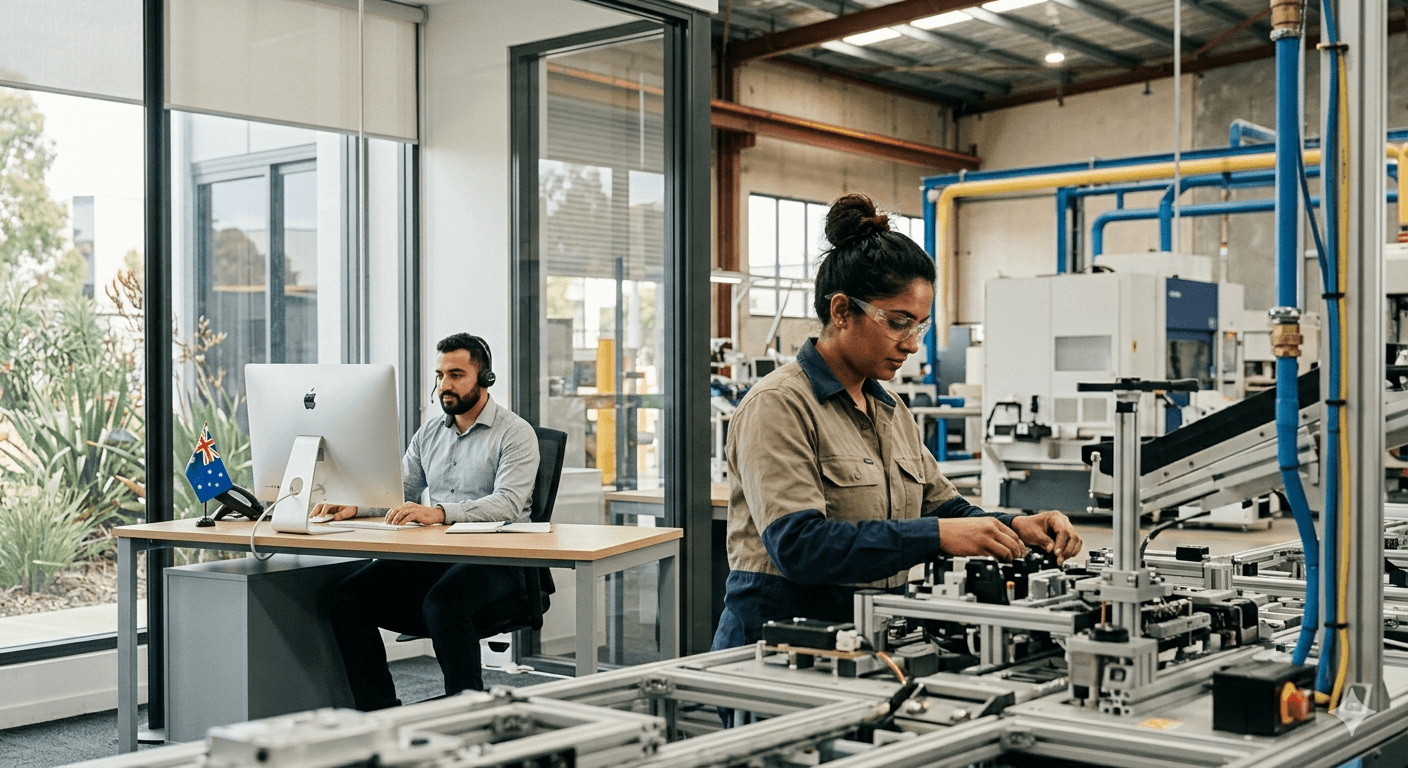
The idea of remote professionals isn't new. But in manufacturing, it's often been overlooked because the industry is so operationally hands-on. If you need someone to operate a machine or inspect a product, they need to be on-site. That's obvious.
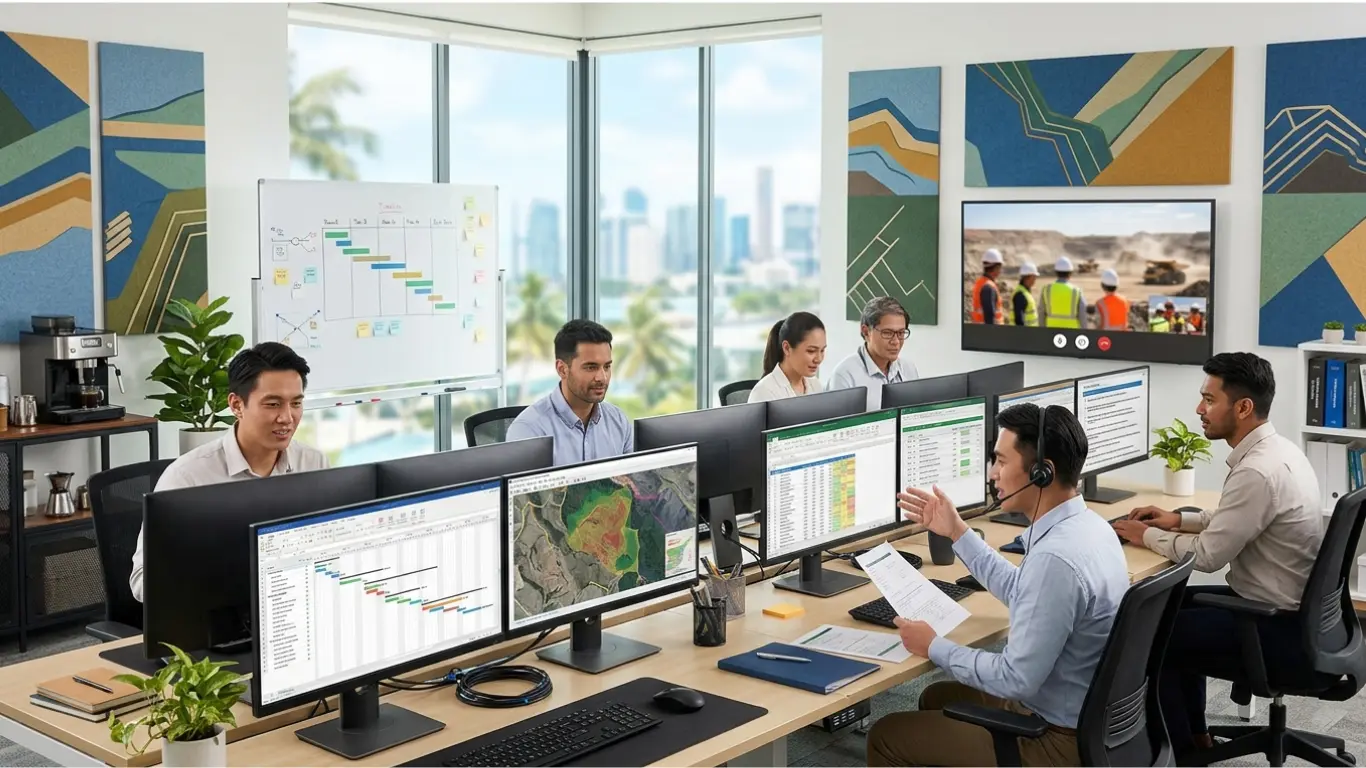
What's less obvious until you map where your team's time actually goes is how much of a typical manufacturing operation runs on work that has nothing to do with the floor. Customer service. Order management. Supplier correspondence. Finance administration. Reporting. Compliance tracking. These are all functions where quality and reliability matter far more than physical location.
A dedicated remote professional typically costs 50 to 70 percent less than an equivalent local hire, once you factor in salary, superannuation, office space, equipment, and recruitment costs. Onboarding takes weeks, not months. And the engagement can scale as your needs change without another lengthy recruitment process.
What to Outsource and What to Keep In-House
The most common mistake manufacturers make when they first consider remote staffing is being too vague about what they need, or trying to hand off too much too quickly.
The functions that work best for remote support share a few characteristics: they're process-driven, they don't require physical presence, they involve regular communication via digital tools, and they benefit from dedicated attention rather than being squeezed in around other priorities.
Good starting points for most manufacturers include:
Order processing and customer communications. Typically high volume, time-sensitive, and well-suited to someone whose sole focus is managing that pipeline accurately and responsively.
Supply chain administration. Vendor correspondence, purchase order management, shipment tracking, and inventory reporting all translate well to remote support especially when your logistics team is already stretched.
Finance and accounts. Accounts payable, accounts receivable, payroll administration, and financial reporting are functions where accuracy matters far more than proximity. Many manufacturers find that experienced remote finance professionals deliver the same quality of work at a fraction of the cost.
Compliance and ESG coordination. Tracking environmental metrics, managing certification renewals, preparing compliance reports, and coordinating documentation across departments is exactly the kind of structured, methodical work that suits a dedicated remote professional.
Administrative and executive support. Scheduling, reporting, document management, and internal coordination are often handled by people who are overqualified for them internally. Freeing up your operations manager from these tasks pays dividends quickly.
What a Good Remote Staffing Partnership Actually Looks Like
Not all remote staffing arrangements deliver the same outcomes. For manufacturing businesses in particular, a few things make a significant difference.
Dedicated staff matter more than shared resources. Your remote professionals should work exclusively for your business, not split their time across multiple clients. Manufacturing operations have specific systems, terminology, and ways of working. That knowledge builds up over time and is genuinely valuable you want someone who knows your ERP, understands your supplier relationships, and can anticipate what your team needs without being asked.
Time zone alignment is non-negotiable for customer-facing roles. If your remote customer service professional is working while your customers are asleep, the arrangement won't work. AEST-aligned teams are essential for any function that requires real-time responsiveness.
Structured onboarding is what separates a smooth transition from a frustrating one. Look for a provider who has a clear process for documenting your workflows, introducing your systems, and supporting the handover from local to remote support.
HR and performance management should sit with the provider, not with you. One of the genuine advantages of working with a dedicated remote staffing partner is that recruitment, HR oversight, and performance frameworks are handled on your behalf. If a replacement is needed, the provider manages it without the usual recruitment process landing back on your desk.
Where to Start
If you're considering whether remote staffing is right for your manufacturing business, the most useful exercise is straightforward: write down where your current team's time goes, and identify which tasks are consuming hours that could be better spent elsewhere.
Most manufacturers who do this find two or three functions where the workload has quietly grown past what the existing team can comfortably handle. That's the starting point for a real conversation.
The manufacturers building remote support teams right now aren't doing it out of desperation. They're doing it because they can see that businesses still running entirely on traditional local hiring models are going to find the next few years increasingly difficult to navigate. Building a flexible support layer while things are still manageable is a much better position than scrambling to do it under pressure.
About My Virtual Mate
My Virtual Mate helps Australian manufacturers build dedicated remote support teams across administration, customer service, supply chain coordination, finance, and compliance. Our professionals work exclusively for your business, in your time zone, using your systems.
If you'd like to explore whether a remote staffing solution is the right fit, book a free discovery call with our team.
Frequently Asked Questions
1. Which manufacturing roles can be supported remotely?
Any role that doesn't require physical presence on the production floor. The most common starting points are customer service, order management, finance administration, procurement support, supply chain coordination, and compliance documentation.
2. How long does it take to get someone started?
Most clients have a qualified professional onboarded and operational within two to four weeks compared to the three to four months a local recruitment process typically takes.
3. Do remote professionals work with our existing software?
Yes. Remote staff use your systems your ERP, your CRM, your communication platforms exactly as a local employee would. A structured onboarding process gets them up to speed before they begin operating independently.
4. Is this cost-effective for smaller manufacturers?
Particularly so. The model works well for small and mid-sized operators who need reliable support across multiple functions but can't justify the full cost of a local hire for each role.
5. Who manages the remote staff day to day?
You direct the work. My Virtual Mate handles HR, performance frameworks, and any staffing changes so the management overhead doesn't fall back on your team.
6. What if we only need one person to start?
Most clients begin with a single role and expand from there. There's no minimum team size, and engagements are structured to match where your business actually is right now.